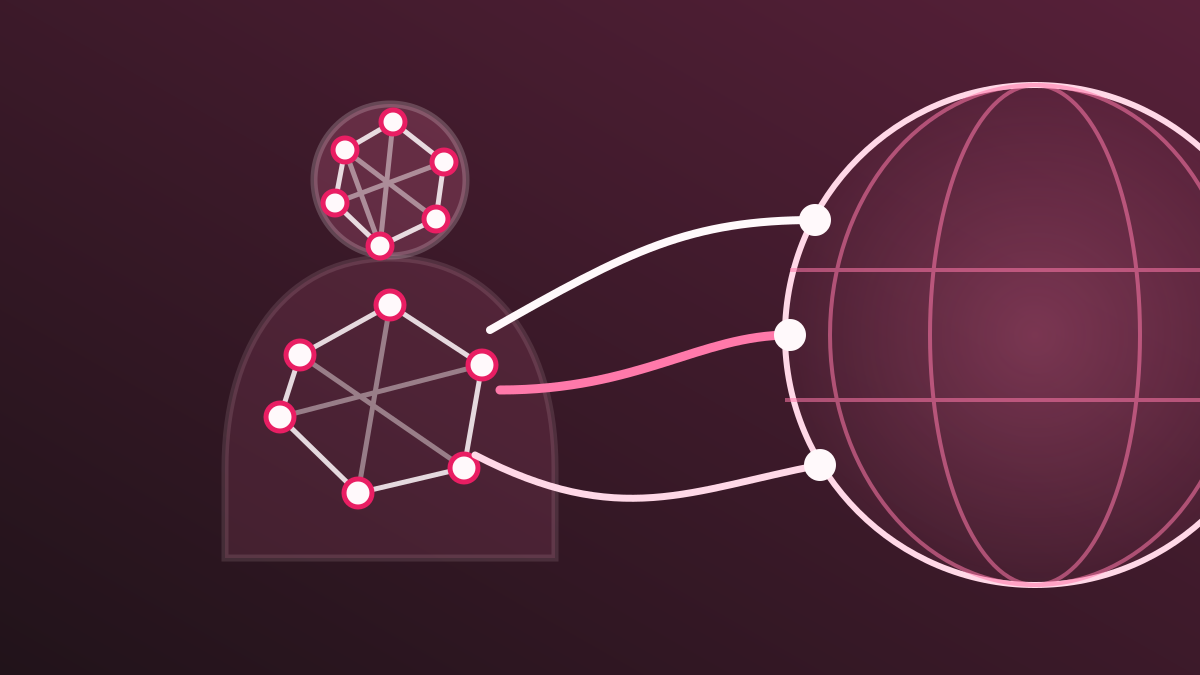
I began this series with the claim that I do not think we have ultimate free will. We make choices, but there is no uncaused captain inside us who chose the mind doing the choosing. Each decision emerges from a person with a particular biology, history, environment, and present state, none of which they ultimately authored.
Table of contents
On this page
Caused Is Not Clockwork
When I call ours a caused world, I mean that our actions arise from conditions and processes we did not ultimately choose. I am not claiming that every fundamental event has a sufficient cause or that only one outcome is physically possible.
Causal does not necessarily mean strictly deterministic. Causal determinism is the stronger thesis that the state of the world and the laws of nature fix everything that follows. Whether our universe satisfies that thesis remains disputed. Causation can also be probabilistic, where a condition changes the likelihood of an outcome without guaranteeing it.
Some events may be genuinely random. An apparently non-deterministic event might instead reflect an incomplete model. Many systems are chaotic, meaning tiny differences can produce radically different results even under deterministic laws. Much of what matters to us is simply unknowable because we lack the information and computing power. Determinism, randomness, chaos, and predictability are different questions.
None of these possibilities creates ultimate authorship. If an outcome was fixed by prior conditions, I did not originate those conditions. If a random event helped settle it, I did not choose the result of that randomness. If the process was too complicated to predict, my ignorance did not create freedom inside it. Unpredictable is not the same as self-created.
Nothing Real Has Been Explained Away
An emotion does not become unreal when we understand some of its causes. Fear still tightens the chest. Grief still aches. Love still changes what a day feels like. Explanation can alter how I relate to a feeling, but it does not erase the person experiencing it.
P. F. Strawson called emotions such as resentment, gratitude, guilt, and forgiveness our reactive attitudes. He thought they were woven into ordinary relationships too deeply to be discarded. Strawson was defending a kind of moral responsibility that I question, but I think his observation about human life was right. We are not going to reason ourselves into becoming emotionally neutral observers of one another.
I do not think the goal is to eliminate anger. Anger can register that something is wrong. It can provide energy to object, protect, organise, or leave. What I want to loosen is moral hatred, by which I mean the wish for somebody to suffer simply because they ultimately deserve suffering. I can say, “This must stop”, without saying, “Your pain would be good in itself.”
That distinction will not always appear neatly in the moment. Someone who has been harmed does not owe anyone immediate calm, empathy, or philosophical consistency. Anger has causes too. We can allow it to exist without letting its most punitive impulse decide what justice should become.
Grief also survives intact. Knowing that a death, separation, or lost possibility arose through causes does not make the absence smaller. There is no intellectual shortcut around mourning. A caused loss is still a loss.
Pride and gratitude remain as well. I can be proud that I persisted and pleased with what I made, while remembering how much luck supported my ability to persist. I can thank someone for their kindness without imagining that they created their own capacity for kindness from nothing. Gratitude can even widen when I notice how many people and circumstances made a good moment possible.
Guilt and regret need some care. A broad review of research on moral emotions found that guilt focused on a specific behaviour tends to be associated with apology and repair, while global shame about being a bad person tends more towards withdrawal and defensiveness. These are tendencies, not laws. Still, the distinction is useful. I can acknowledge that I caused harm, apologise, repair what I can, and change the conditions that produced it without deciding that my whole being deserves contempt.
Regret can also teach. I may believe that I could not have acted differently in that exact past moment and still examine alternatives now. Imagining a better response becomes information for the next moment. The past cannot be changed, but reflecting on it can change me.
Love does not require an uncaused lover. I care about a person as the living, feeling being they are, not as a metaphysical first cause. Learning why somebody became gentle, frightened, funny, or difficult can deepen my understanding without turning them into an object. Their experience remains as real and important as mine.
Everyday Justice Without Hatred
Understanding causes is not permission to ignore harm. If anything, it asks us to respond more precisely. What happened? Who was hurt? What needs to be repaired? What conditions would make repetition more or less likely?
Intent still matters. An accident, a reckless act, and a deliberate attack tell us different things about danger, trust, and what might help. The difference need not establish ultimate desert to remain practically and relationally important.
Everyday justice can include an honest conversation, an apology, restitution, reduced access, or the end of a relationship. Boundaries are not failed compassion. A boundary changes the environment and protects people within it. Sometimes the kindest available response is distance. Sometimes it is blocking a number, reporting misconduct, or preventing somebody from causing further harm.
Compassion does not require trust, reconciliation, or forgiveness. A compassionate response resists needless suffering and asks what might prevent more harm. The harmed person does not have to provide that response. We can understand somebody and still decide that they are not safe to be around.
The same principle scales beyond personal relationships. Consequences may be needed for protection, deterrence, and rehabilitation. They should still be proportionate, evidence-based, and constrained by rights and due process. The philosophical literature on moral responsibility scepticism explores such forward-looking alternatives to retribution. A caused world does not abolish accountability. It gives accountability a job other than revenge.
We Are Causes Too
The most common fear about this view is passivity. If I did not ultimately choose myself, why try?
Because trying is one of the things that changes what happens.
Fatalism says the outcome will occur whatever we do. A causal view says what we do is among the causes of the outcome. Deliberation exposes us to reasons. Goals direct attention. Plans connect situations to actions. None of this has to float outside nature to work.
There is careful psychological evidence for some practical ways of improving those processes. A 2021 meta-analysis found a small-to-medium average benefit from combining realistic reflection on obstacles with specific if-then plans. It also warned that publication bias may mean the true effect is smaller. Plans help on average. They do not grant control over every result.
Habits matter for the same reason. A major review of habit psychology describes how repeated responses become linked to recurring contexts. That gives us a modest tool. If I keep failing in the same environment, I can try changing the cue, reducing friction around the useful action, or adding friction around the harmful one. Willpower does not have to do every job.
Therapy can introduce new interpretations, coping skills, and patterns of behaviour. The National Institute of Mental Health notes that different evidence-based therapies suit different problems, and no treatment works equally well for everyone. Education can add knowledge, examples, and skills. Supportive communities can make some actions easier and others less necessary. These things matter because they enter the causal stream.
That is not glamorous, but it is hopeful. Sleep, medication, food, money, safety, good information, and decent company can change what a person is able to do. If we want different behaviour, we should care about the conditions producing it.
Hope Under Uncertainty
A caused world is not a known world. Surprise may come from randomness, chaos, hidden information, another person’s behaviour, or an assumption I did not realise I had made. Surprise reveals the limits of my model. It does not reveal an uncaused self.
Planning remains sensible because uncertainty comes in degrees. I cannot guarantee rain, but I can carry a coat. I cannot guarantee that a difficult conversation will go well, but I can choose the time, prepare my words, and decide what I will do if it goes badly. If the world is deterministic, those preparations become part of what determines the outcome. If it is not, they can still improve the odds.
Hope is not a prediction that everything will work out. It is not a belief that the world owes us a happy ending. Some losses are permanent. Some circumstances are awful. Some people will not change. Hope can be smaller and more honest than optimism. It can mean that, for all I know, another outcome remains possible and there is something worth doing now.
Meaning Without Ultimate Authorship
Meaning does not need to arrive from outside causality. The philosophy of meaning in life contains many naturalist accounts grounded in relationships, knowledge, creativity, worthwhile goals, and contributions to others. There is no consensus on one formula, which seems appropriate. Human lives contain more than one kind of value.
A caused song can still be beautiful. A caused act of care can still relieve pain. A caused friendship can still hold two people together through an unbearable year. Their histories do not cancel their significance. They are part of what gives them significance.
Living fully does not mean feeling good all the time or turning every wound into a lesson. It includes delight, boredom, effort, rest, love, grief, failure, surprise, and occasionally getting things badly wrong. None becomes less vivid because it arose within nature.
For me, doing our best means using whatever agency we have to reduce avoidable harm, repair what we can, and improve the conditions of the next choice. We do that for ourselves, one another, and the world we live in. “Best” does not mean perfect. We act with limited knowledge, unequal capacities, and no guarantee of success. We can listen, update, repair, and build conditions that make better outcomes more likely.
I do not know whether reality is strictly deterministic. I do know that luck is everywhere, certainty is scarce, and our actions affect other conscious lives. That is enough reason to protect what can be protected, change what can be changed, mourn what cannot, and enjoy what happens to be good.
Anyway, I didn’t choose what I just wrote. But then, that was rather the point.